seeding the spelt

Suiting Up


Saturday, Lee turned the field over in preparation for Sunday's seeding. He arrived early in the morning, fed the animals, and then harnessed up Charlie and Jane, getting them ready for their work day.


Filling the Seeder


After driving the team from the barn to the field, Lee filled the hopper with spelt seed. If you are not familiar with the plant, it is a short grain in the wheat family. The plant has been sewn for thousands of years and was popular in the Mid East and Europe during medieval times.


Seeding Spelt


Spelt is the farm's winter crop. The grain will grow until it is harvested in June. I'll be sure to post pictures during the next few months so that you can see the field in the upcoming seasons.


Pulling Hard


I enjoy watching the powerful animals working. Their muscles ripple and stretch as they pull the seeder through the field. I definitely have the sense that they enjoy the work.


Haw, Haw, Haw


At the end of each row, Lee turns the team around by hollering Haw… Haw… Haw. Hee for right, Haw for left. The horses know just what to do and coordinate their efforts around the turn and back down the field.

I watched the trio in action all morning, and when Lee took a break, we talked for a while. I could smell the turned earth and the fallen leaves. There was a cool, chilly breeze early on and then the sun warmed the morning up. I know that later this winter, when the cold and snow has forced us indoors for far too long, I can draw upon my memories of this day and hear, smell, and see Lee and crew in action. It's these kinds of memories that carry us northerners through the long winters.


jane and charlie

Morning Pasture 2


Saturday morning, I visited Jane and Charlie in the main pasture. I love the morning light and the way the trees and barn are lit up by the sun.


Morning Pasture 1


The morning air was crisp and chilly. Perfect for getting out of bed and greeting the day. So, I packed the gear and headed for the farm. When I first arrived, the sky was still dark. By the time I left, the sun had cleared the horizon. So, I started with the tripod and ended hand held. Not a bad way to spend your Saturday morning.

bird on a board

Bird on a board


I'll bet that as you were laying in bed this morning, trying to figure out if you were awake yet, that you were thinking that a bird on a board would be the perfect start to your day. I agree with you, that would be a perfect way to start your day and even your week.

I can't bring you a real bird on a real board because I don't know where you live and the bird would probably fly off when I tried to pick the board up. I can bring you this picture of a bird on a board. When you think about it, the picture is probably the better way to go. It's portable and the bird never takes off just when you need him the most.

Enjoy your bird on a board. It is a gift from me to you. You are welcome.


sorghum syrup

Sorghum Canes


A couple weeks back, we took a look at sorghum growing in the field and I told you that it used to be turned into a sweet syrup back in the old days before cane sugar became so cheap. You can still find it in the south but it is no longer mass produced. I thought you might like a recipe for making your own sorghum syrup. I will assume that you probably have an acre or so of the sorghum cane harvested and ready to go.


Mules on a Hill


The first thing you should do is pick a nice cool morning and get up early. The process is pretty hot so you won't want a warm day. If your mules are already awake in the pasture, you probably over slept. 


Making Sorghum Syrup 3


Making Sorghum Syrup 4


Making Sorghum Syrup 7


Your set up should look something like the pictures shown above. Waggons full of sorghum cane, water wagon and steam engine. You can use your draft horses to pull everything into place. You do have draft horses don't you? A friend to help is a good idea. Pick somebody with a weak mind and a strong back for the best results.


Making Sorghum Syrup 9


Making Sorghum Syrup 8


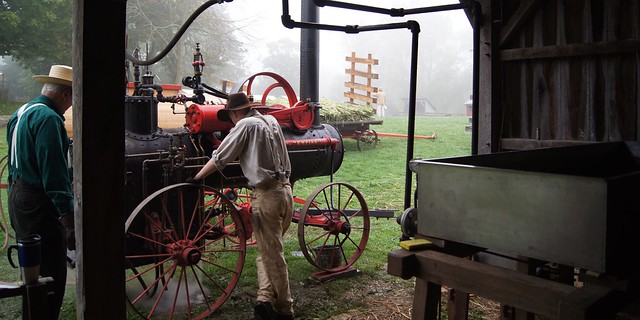
Next, you will want to fire up your steam engine. You do have a steam engine don't you? You don't? You sure you are really dedicated to becoming a sorghum syrup maker? Maybe you can borrow your neighbors steam engine. You will need it to press the canes and boil the juice. Go ahead and get going, I'll wait.


Making Sorghum Syrup 5


if you reach up and fiddle around with these valves every few minutes, you will make people think you really know what you are doing. They don't really do anything, but part of the process involves looking cool.


Oil Can


Keep an eye on the oil level as well. If you begin to run low, you can add some from your oil can. Be sure to use authentic steam engine oil.


Making Sorghum Syrup 11


When your engine has a good head of steam, give it a test run to check that everything is working to order. If your neighbors are sleeping, give a tug on the rope and blow the steam whistle. They will probably appreciate that you are looking after them. Nobody likes to sleep in.


Making Sorghum Syrup 12


Making Sorghum Syrup 1


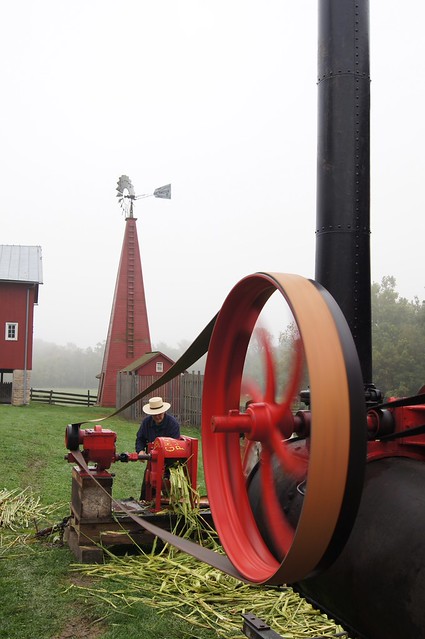
If everything is running ok, connect your steam engine's drive wheel to your press using a long leather belt. Give the engine some steam and your are ready to go. Start feeding in your sorghum canes.


Making Sorghum Syrup 10


The press will crush the sorghum canes and free up the juice. You will want to collect the juice in a clean bucket. At this point he juice is a watery sweet liquid with a slight grassy taste.


Making Sorghum Syrup 6


Once you have collected the juice, pour it into your steam boxes and use the steam from your engine to heat the steam boxes.


Making Sorghum Syrup 2


The heat will boil the sorghum juice down to a syrup. Every once in a while, skim off the green stuff. You don't want the green stuff. Green stuff is bad, it looks ugly and tastes like grass.

Once you have the syrup all cooked up, you will have enough for the next year. Enough for you and your neighbors, friends, relatives and people that you don't really like, but you have to be nice to, because you work with them.

Now have your favorite cook person make you a big stack of pancakes and biscuits because you have syrup and nothing to put it on! Go on, get going, we are done here.


the watering trough

Watering Trough


If you know me, you know that I never tire of the simple scenes and images of rural life. This picture is a perfect example. No animals, no machinery, just the side of a barn, a watering trough, a fence and, a foggy landscape. When I look at this image, I can hear the silence brought on by the fog and I can feel the cool, crisp, and damp morning air.

As simple as the scene is, the red wall seems to take away from the watering trough. I wondered if I could simplify the scene even more and place the focus squarely on the water.


Watering Trough B&W


And, it seems that I could. The B&W conversion neutralizes the red wall while bringing your eye to the water's surface. Simplicity… simplified.


charley’s lunch pail

Charley Forgot his Lunch


On his way to check on the display barn, Charley left his lunch pail on the picket fence that surrounds the area. With the barn inspected and pronounced ready for the day, Charley returned to retrieve his lunch. Knowing the crowds that would soon descend on the farm for the fall festival, the poor man is going to need the calories. Keep a good eye on your lunch Charley or it just might disappear. Now, I am feeling hungry.


donkey!

The Farm Gets a Donkey


Carriage HIll Farm now has a donkey. No name for the little addition just yet, but if they don't name it soon, I'll name it for them. Why did they get a donkey and why is it in the same pasture as the sheep?


Foggy Flock


The farm has been having a problem with coyotes killing the young sheep. Turns out that a donkey is more than capable of protecting the sheep from the coyotes. Indeed, donkeys have been known to kill the predator. I don't care how big your teeth are, you don't mess with a donkey. No Sir. Just leave the donkey and his friends, the sheep, alone.


Sorghum

DSC09021


You have never seen sorghum? I am not surprised. Sorghum is not a common plant any more and when you do see it, you might be forgiven if you think you are looking at a field of corn.


DSC09024


Just like corn, sorghum grows on a tall stalk with long hanging leaves. However, if you look closely, you will see that there are no ears on the stalks.


DSC09022


At the top of every stalk is this bunch of fruit that looks like berries. These are the seeds.

What do you do with sorghum? Well, you make syrup with it. The canes are cut down and passed through a grinder, squeezing out the juice in the process. The juice is then boiled down to make a sweet amber colored syrup. Think of slightly bitter sweet molasses and you will have some idea of what sorghum tastes like.

While not very common in the North, Sorghum syrup can still be found in some areas of the South, like northern Georgia. I have eaten biscuits with sorghum syrup many times and can tell you that it is worth eating, if you can find it. Just like maple syrup or honey, a jar can sit on the shelf for a long time, so bring one home  and enjoy the sweet flavor of sorghum syrup for months to come.

Consider this a tip from your friend Tim. I would not steer you wrong when it comes to good eating.